
Hexmat History
An overview of the milestones of our journey into the world of audio playback and vibration control.
“Same Grooves, New Vibes”
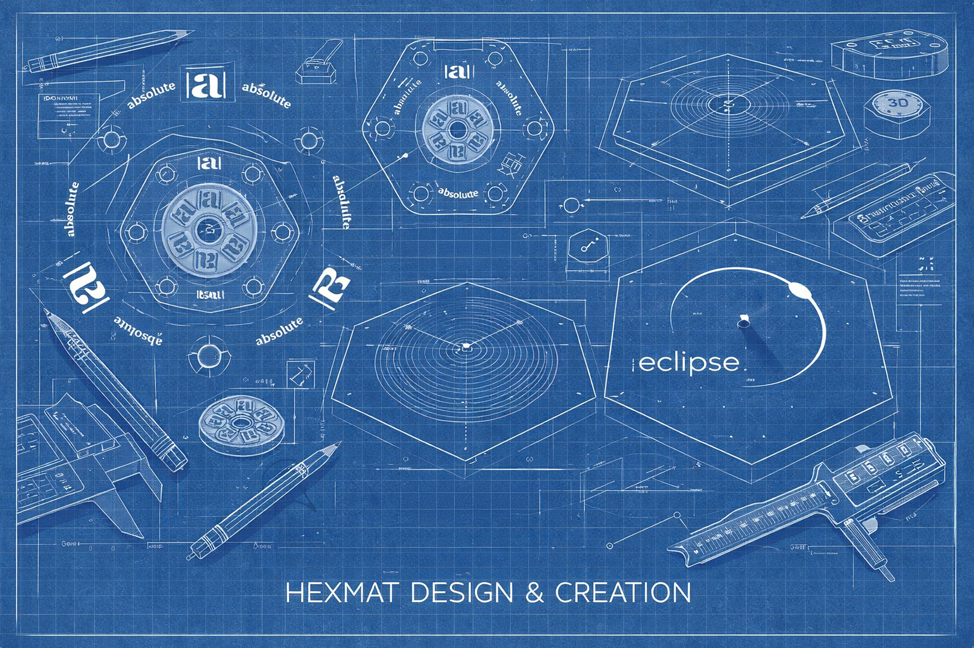
Hexmat Isolator Blueprints
Hexmat was founded on the vision of Zsolt Fajt, a Budapest-based entrepreneur with a strong technical background and a lifelong exposure to high-fidelity audio. Influenced early on by his father’s deep understanding of hi-fi systems, he developed a disciplined appreciation for sound reproduction and the importance of continuously refining audio setups to extract their full potential.
This foundation led him to train as a sound engineer and establish a recording and mixing studio in Budapest. Over the years, he contributed to numerous Hungarian and international productions, gaining extensive practical insight into the precision and standards behind professional audio recording, mixing, and mastering.
The turning point came approximately 25 years ago with the acquisition of a Thorens TD320 MK2 turntable. What followed was a prolonged pursuit of sonic perfection. Despite experimenting with increasingly sophisticated equipment—turntables, cartridges, cables, clamps, and isolation accessories—persistent issues remained: sibilance distortion, unstable bass response, limited spatial definition, and restricted dynamic headroom.
From an engineering standpoint, these shortcomings appeared inconsistent with the inherent quality of analog recordings. Since professional audio production adheres to strict and highly controlled standards, it became clear that the limitations were not embedded in the vinyl medium itself, but rather in the playback environment.
Through systematic analysis, Hexmat’s founder identified a critical factor: uncontrolled vibrational energy. During playback, acoustic energy generated by loudspeakers propagates through the air, reflects within the listening environment, and re-enters the playback system. These spurious vibrations interfere at the stylus-groove interface, introducing phase distortion and compromising tracking accuracy—effects that intensify with volume.
Additionally, the stylus operates under a complex system of forces at a microscopic scale, including vertical tracking force, centripetal and centrifugal forces, and friction. Precise balance among these forces is essential for accurate groove tracking, yet conventional solutions often rely on increasing mass and surface contact to dampen vibrations.
Hexmat emerged from a fundamentally different approach.
Instead of increasing mass, the concept focused on minimizing the contact surface between the record and its support. By reducing this interface to near-zero—approximately 1–2 square millimeters—the record is effectively decoupled from the underlying structure. This radically alters how vibrations are transmitted and dissipated.
The resulting HEXMAT isolator employs a carefully engineered internal structure and material composition to isolate harmful vibrations while enabling efficient energy transfer. Its design allows the vinyl record to retain its natural damping characteristics, leading to improved transient response, enhanced clarity, and reduced harmonic distortion. Previously masked details in recordings become perceptible, and overall sonic accuracy is significantly improved.
Instrumentational measurements support these observations, demonstrating improved dynamic behavior and reduced noise levels, attributed to more precise groove tracking.
Although the concept originated more than 15 years ago, it took time and the right circumstances to bring it to life. Over the past several years, development intensified, resulting in more than 100 prototypes. A wide range of materials was tested, including polymers, stabilized woods, metals, ceramics, and composite structures. Each variation contributed to a deeper understanding of how material combinations influence acoustic performance.
Today, Hexmat represents the culmination of this iterative process. Manufactured in Budapest, each unit is individually produced and inspected to ensure consistent quality. The technology is protected by international patent, and the current product line marks the first step in a broader roadmap that will explore additional material configurations and performance characteristics.
Hexmat stands as a precise engineering response to a long-standing problem—redefining how vinyl playback systems manage vibration, and ultimately, how music is experienced.